
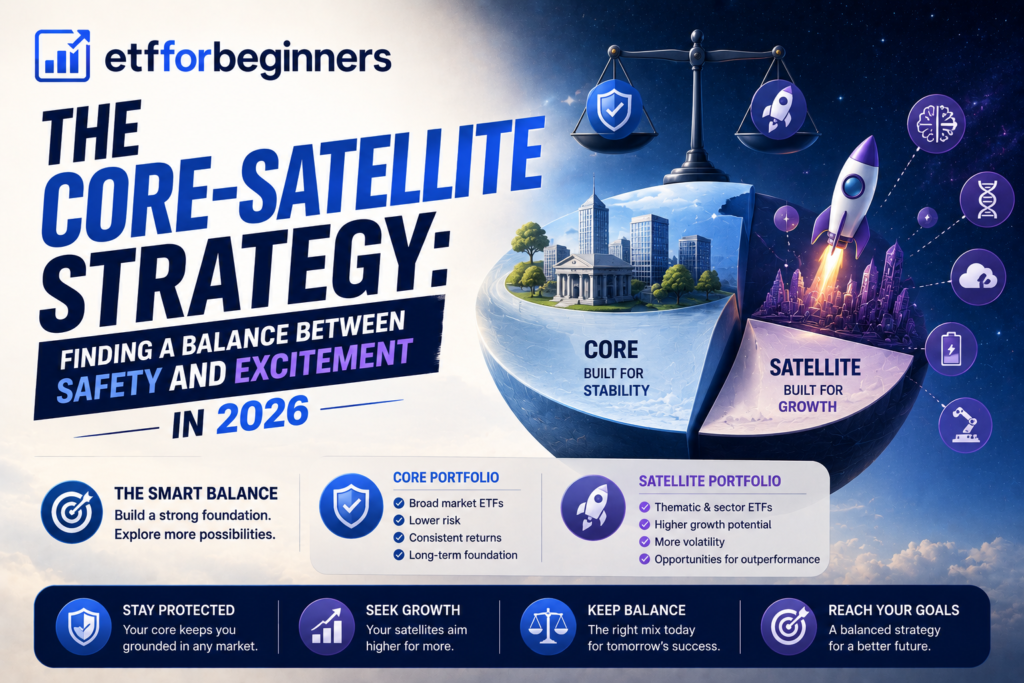
For many new investors at etfforbeginners, the real trick isn’t just getting started; it’s staying interested over time. We often hear that boring investments are better and that putting all your money into one global fund is enough. While that might make sense on paper, people naturally want a bit more thrill. We see amazing new technologies popping up, like advancements in green energy and artificial intelligence in 2026, and we naturally want to be part of those specific trends. That’s exactly where the Core-Satellite Strategy fits in. It’s a smart but straightforward way to invest. You can keep most of your money (say, 80%) in a steady, worldwide fund, think of it as your safe base. Then, you use the other part (the remaining 20%) to go after bigger gains in specific areas or industries you’re excited about. It’s like finding that sweet spot between being super disciplined with your money and still going after some big investment dreams.
The «Core» of your investments is like the solid foundation for your financial future. By 2026, ideally, this main part should make up about 70% to 90% of all your money. The point of this core isn’t to outperform the market, but just to match what the market does. So, for this, we usually put money into broad, low-cost funds, like ones that track the S&P 500 or the entire global stock market. Experts like Vanguard, who study how to build investments, say this core is what keeps things steady and helps your money grow slowly over many years, so you stay on track. You never gamble with this money; it’s what lets you sleep soundly at night. Putting most of your funds here makes sure that even if your more specific, risky investments don’t pan out, your main retirement savings stay safe.
Satellites
After we’ve set up the main part of our investments, we then look at what we call «Satellites.» These are smaller, more specific investments, usually taking up 5% to 10% of your total. They’re typically in specialized funds (ETFs) that you think will do better than the overall market in the coming ten years. For instance, in 2026, many people might choose satellites that focus on things like cybersecurity, semiconductor companies, or growing markets such as India. The idea behind this is what some call «Calculated Aggression.» You’re not putting all your money into these areas, but you are giving yourself a chance to make extra money, if these industries suddenly take off. This lets you feel like you’re picking winners without risking all your savings in sectors that can be very up and down. What’s great about this strategy is how it helps manage risk. As financial pros at Investopedia point out, the Core-Satellite approach really helps to keep your overall portfolio from straying too far from the general market’s performance. Imagine putting every penny into a Robotics fund; if that industry has a tough year, you’d be in serious trouble. But if Robotics is just a small 5% piece of your pie, and the big 80% main part of your portfolio is doing fine, then a bad year for robots won’t hurt much. It’s more like a small bump in the road. This setup means you can be wrong about some of your smaller bets without them completely messing up your finances. It essentially makes investing feel like you have limited downsides and unlimited upsides, which is where every smart investor wants to be. By 2026, these «Satellites» also become a neat way to make sure your investments match your personal beliefs. Lots of people want their money to work for causes they care about, whether it’s helping the environment or promoting social fairness. With satellites, you can lean your investments towards these values using special funds (called ESG ETFs) that focus on environmental, social, and governance issues, all while keeping your main investment in a regular index fund to get typical market returns. This helps avoid that Performance Gap that sometimes happens when people put all their money into impact funds, which might not do as well as the broader market at certain times. So, you can support the kind of future you want to see, while still making sure your own financial future is secure.
One big thing about the Core–Satellite approach is keeping your costs down. Since the Core uses really cheap ETFs, often with fees less than 0.07%, your total portfolio cost stays pretty low. This is true even if your Satellites have higher fees, which is common with specialized or actively managed ETFs. For instance, if you have 80% of your money in something that costs 0.05% and 20% in something that costs 0.50%, your average cost comes out to just 0.14%. That’s much less than what you’d pay a regular financial advisor or an actively managed mutual fund.Keeping those main costs low is the best way to grow your money over three decades.
The market in 2026 often involves Sector Rotation, where different parts of the market take turns leading, like tech, then energy, then healthcare. Trying to constantly switch your whole portfolio to follow these changes is usually a bad idea. But with a Core-Satellite setup, your main investments are already in the market, so you can use your smaller satellite investments to gently lean into sectors you think are currently undervalued. This strategy is called Tactical Asset Allocation. Think of it like a big cruise ship, which is your core, staying on a steady path, while a few small jet-skis, your satellites, can zip around to check out interesting parts of the ocean. However, investors need to watch out for Satellite Overlap. In 2026, it’s pretty common for your broad S&P 500 core to already have about a 30% investment in technology. If you then add a Big Tech Satellite and a Cloud Computing Satellite, you might accidentally put 60% of your money into the same five companies, like Apple, Microsoft, and Nvidia. That’s why at etfforbeginners, we really emphasize checking the Holdings list on your ETF’s factsheet. A good satellite should offer something your core doesn’t already cover, maybe exposure to smaller companies, different places like emerging markets, or specific things like gold or silver.
Lastly, let’s talk about how to rebalance your satellites. If one of your satellite investments does really well, for example, an AI ETF triples in value, it could easily grow from 5% of your total investments to 15%. While that’s a good problem to have, it means your little jet ski has suddenly become a medium-sized boat, and it’s starting to pull your big cruise ship off its planned route. A smart investor knows to take some of those profits. You sell off that extra 10% and move the money back into your main, stable investments, what we call your Core. This is essentially the classic buy low, sell high strategy at work. You’re cashing in on your riskier, high-flying winners and securing those gains in your safe, long-term foundation. So, to sum it up, the Core-Satellite approach is a fantastic solution for investors looking ahead to 2026. It offers everything an investor wants: the security you get from index funds, the thrill of fast-growing industries, and a smart way to manage risk. Instead of just passively watching, this strategy helps you actively build your wealth. When you create a big, solid core, you then have the freedom to explore those satellite investments. It’s more than just a way to manage money, it’s about managing your own natural tendencies, helping you stay invested, keep learning, and make money for decades to come.
Here at etfforbeginners, we truly believe the best investment plan is the one you can stick with, no matter if the market is quiet or crazy. The Core-Satellite idea really gives you the best of both possibilities. Start by focusing on making your core strong today. Once that’s rock-solid, then and only then, you can start looking for those satellite opportunities.